In the manufacturing industry with overcapacity and fierce competition, the core competitiveness of enterprises is no longer simply production scale, but the well-organized management capability. System management acts as the operating system of an enterprise. Though invisible, it enables efficient coordination among research and development, production, procurement, quality control and other links. It not only maintains the bottom line of compliance, but also stimulates the potential for long-term growth.
Today we will analyze the core logic of Zhengcun system management from four dimensions.
1 System Composition
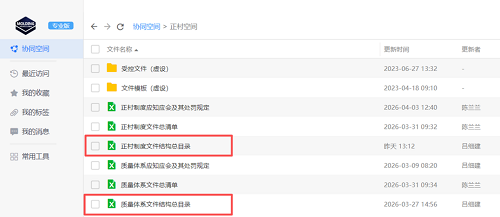
The company’s management system is divided into quality system and Zhengcun regulations.
1.1 Quality System
It covers all requirements specified in the quality management system standards IATF16949 and ISO9001.
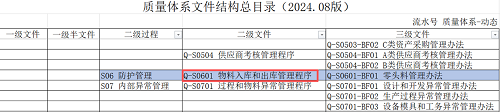
For example, Clause 8.5.4.1 of IATF16949 stipulates that the first-in first-out principle shall be adopted in inventory management. The Material Receipt and Dispatching Management Procedure, which converts such warehouse management requirements in standards into management policies, falls within the scope of the quality system.
1.2 Zhengcun Regulations
It includes all regulations other than those specified by the quality system.
For instance, corporate financial management requires cost analysis and control in advance, during and after implementation, while such requirements are not involved in quality management standards. The Financial Management Procedure formulated accordingly belongs to Zhengcun regulations.
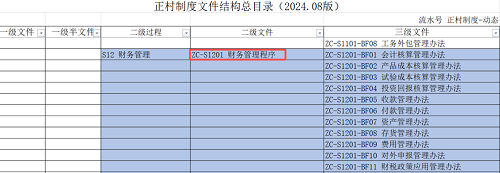
2 Management Policy
It adopts a process-oriented mode, integrating all management elements into corresponding processes for management.
For example, personnel recruitment management elements are placed under the human resource management process for supervision. All management elements of the company are incorporated into relevant process management without exception.

3 Process Orientation
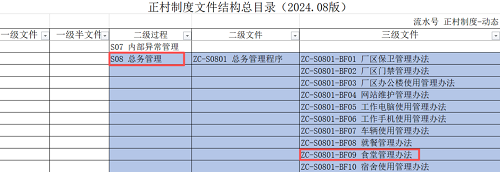
Every problem arising within the company is regarded as a part of relevant processes.
For example, the catering quality of staff canteen falls into the general affairs management process.
4 Management Elements
4.1 Definitions of Management Elements
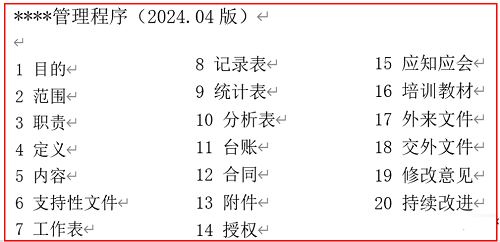
There are 20 management elements in total, including purpose, scope, responsibilities, definition, content, supporting documents and so on.
4.1.1 Purpose
It refers to the goals and expected effects to be achieved by formulating relevant regulations.
Example: Item 1 Purpose in Customer Complaint Management Procedure.

4.1.2 Scope
It refers to the business scope covered by relevant regulations.
Example: Item 2 Scope in Customer Complaint Management Procedure.

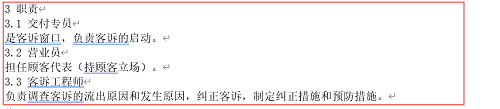
4.1.3 Responsibilities
It defines the work content, duty scope and authority boundary of all relevant personnel involved in the regulations.
Example: Item 3 Responsibilities in Customer Complaint Management Procedure.
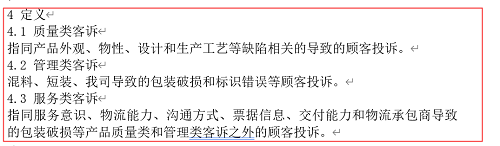
4.1.4 Definition
It explains and defines professional terms used in the regulations.
Example: Item 4 Definition in Customer Complaint Management Procedure.
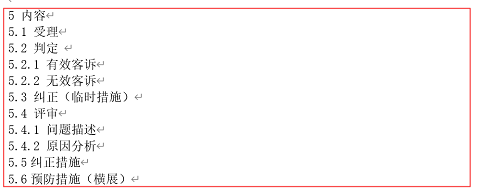
4.1.5 Content
It gives a detailed description of business processes stipulated in the regulations.
Example: Item 5 Content in Customer Complaint Management Procedure.
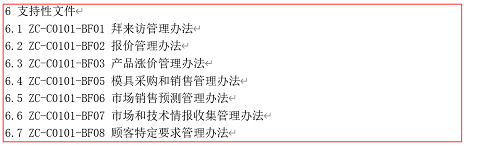
4.1.6 Supporting Documents
As secondary documents, management procedures convert the quality policies in the primary-level
Quality Manual into specific management policies, which are not directly operable. While the supporting management methods of procedure documents convert management policies into detailed implementation rules, serving as operation guidelines for business staff.
Example: Item 6 Supporting Documents in Business Management Procedure.
4.1.7 Worksheets
They are records of planning work involved in relevant processes.
Example: Item 7 Worksheets in Training Management Procedure.

4.1.8 Record Forms
They are records of practical implementation work in relevant processes.
Example: Item 8 Record Forms in Customer Complaint Management Procedure.

4.1.9 Statistical Forms
They are summaries of business data involved in relevant processes.
Example: Item 9 Statistical Forms in Customer Complaint Management Procedure.

4.1.10 Analysis Forms
They classify business data of relevant processes to observe development trends and find out abnormal conditions.
Example: Item 10 Analysis Forms in Customer Complaint Management Procedure.

4.1.11 Account Books
They are documents recording information one by one in relevant processes.
Example: Item 11 Account Books in Sales Management Procedure.

4.1.12 Contracts
They refer to contracts signed with customers and suppliers involved in relevant processes.
Example: Item 12 Contracts in Business Management Procedure.

4.1.13 Attachments
They contain contents without unified classification standards involved in relevant processes.
Example: Item 13 Attachments in Business Management Procedure.
4.1.14 Authorization
It refers to the drafting, reviewing and approving regulations of documents in relevant processes.
Example: Item 14 Authorization in Financial Management Procedure.

4.1.15 Required Knowledge and Standards
They refer to professional knowledge and behavioral norms that staff must master in relevant processes. If regulations are compared to laws, required knowledge and standards are moral norms. Item 5 Content in each document is equivalent to laws, and Item 15 Required Knowledge and Standards is equivalent to moral norms.
For example, the 2-meter stacking height limit of goods in warehouse belongs to Item 5 Content, and the requirement for neat and orderly goods stacking belongs to Item 15 Required Knowledge and Standards.
4.1.16 Training Materials
They refer to training contents needed in relevant processes.
Example: Item 16 Training Materials in Customer Complaint Management Procedure.

4.1.17 External Incoming Documents
They refer to documents issued by related parties to the company in relevant processes.
Example: Item 17 External Incoming Documents in Internal Quality Audit Management Procedure.

4.1.18 External Submitted Documents
They refer to documents submitted by the company to related parties in relevant processes.
Example: Item 18 External Submitted Documents in Customer Complaint Management Procedure.

4.1.19 Revision Suggestions
They collect business loopholes existing in relevant processes, which will be revised together during document management review.
Example: Item 19 Revision Suggestions in Customer Complaint Management Procedure.

4.1.20 Continuous Improvement
It records requirements that cannot be implemented temporarily in relevant processes, which will be carried out when conditions are mature later.
Example: Item 20 Continuous Improvement in Production Plan Management Procedure.

4.2 Relationship between Elements and Processes
Management elements are like keys, and processes are key rings. When lifting the key ring, all keys shall be taken along without dropping any.
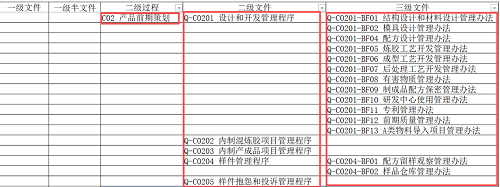
4.2.1 The document structure of management procedures and management methods is composed of various management elements.
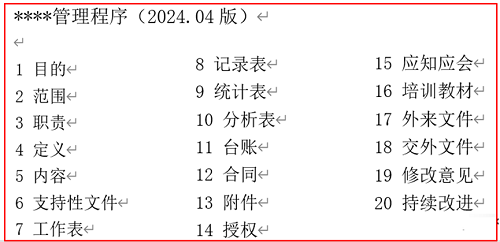
4.2.2 Processes are composed of management procedures and management methods.
For example, when involving the C02 Pre-product Planning process, its corresponding management procedures and management methods will be covered, together with all management elements of this process completely.
System management represents the long-term development philosophy of an enterprise. It is not a task that can be accomplished overnight, but a long-term project requiring continuous optimization. It may not bring a sharp rise in sales volume in a short period, but enables this enterprise operating system to run stably in complex environments, achieving sustained advantages including more reliable quality, higher efficiency, better cost control and stronger risk resistance.
The essence of system management is to establish an internal self-improvement mechanism for enterprises. When every link has standards, every problem has closed-loop solutions and every decision is supported by data, the enterprise operating system can realize continuous iteration and upgrading. Enterprises can gain a firm foothold in the fierce elimination competition of manufacturing industry and truly realize the leap from expanding scale to strengthening strength.